Bat Development & Diversity

Bats are like Darwin’s finches, but weirder

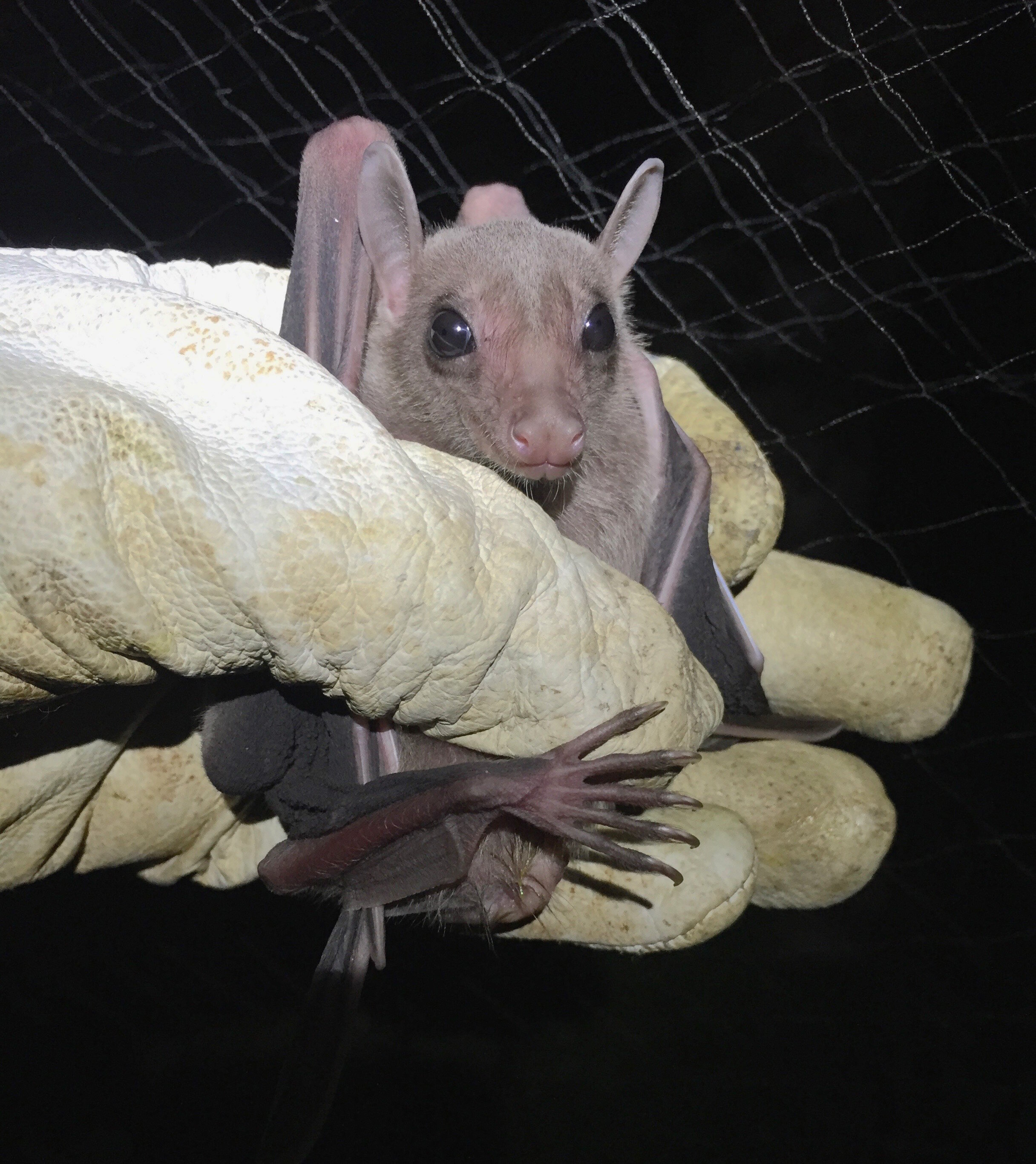
During their history, bats have evolved wings and powered flight, extremely long lifespans, long reproductive health-spans, the ability to tolerate viral infections, and echolocation. They have UV vision, saliva-borne anticoagulants, novel structures, and diverse diets. Bats, therefore, are “natural evolutionary experiments” that we use to study questions of relevance to evolutionary processes and human health, with a special focus on topics relevant to women’s health.


bat.png
Global map_bats2-01.png
 

our research

We travel the world studying bats.

Our research includes bat populations in Puerto Rico, the Dominican Republic, Trinidad and Tobago, Belize, Cameroon, and the Philippines. In all of these locations, we work with local scientists to study the unique traits of the bats of the region.


Bats have incredibly diverse adaptations

Bats have explosively diversified to fill many ecological niches, and today there are over 1200 bat species! Below we describe three of the many unique adaptations in bats that we are studying in the lab.


o1.

Bat aging

Only 19 species of mammal are longer-lived than humans, relative to their body size, and 18 of these are bats. Bats are also the longest-lived mammals, given their body size, with the oldest wild bat (Myotis brandtii) living to at least 41 years — 10 times longer than predicted given its size! Despite their long lifespans, bats seemingly do not “age” like humans; bats remain healthy and female bats fertile even into advanced age.  


02.

Bat teeth and palates

Bats eat all kinds of foods, with diets ranging from fruit to nectar to arthropods and other vertebrates — even blood. These diverse diets are enabled by an equally diverse range in the teeth and hard palates (i.e., the bones on the roof of the mouth) of different bat species. For example, bats that eat hard fruits have short and wide palates that allow them to generate strong bite forces, and fewer but larger teeth. Bats that feed on nectar have very long and narrow palates to support their long tongues, and more teeth that are all similar in size. These food-driven adaptations have led to unique facial morphologies across bat species.


03.

Bat wings (novel traits and wing bones).

Bats are the only mammals capable of powered flight. This flight is made possible thanks to a suite of adaptations in their front limbs. Bats have several wing membranes that act as air foil for flight. Some of these membranes are retentions of embryonic structures (e.g. the webbing between the fingers) while others are truly novel structures that have no direct precursors in the bat ancestor (e.g. the webbing between the bat rear legs and the pinky finger and the body). Bats also have extremely elongated fingers to support these wing membranes: if we were bats, our fingers would be as long as our whole bodies!


Spotlight

Bats as models for healthy ovarian aging

many BATS live extraordinarily long lives—and they don’t just live longer, they stay healthier as they age. One of the most striking examples of this is in females: unlike most mammals, many female bats appear to maintain ovarian function and fertility well into advanced age, offering a rare window into how reproductive systems can remain functional in long-lived mammals.

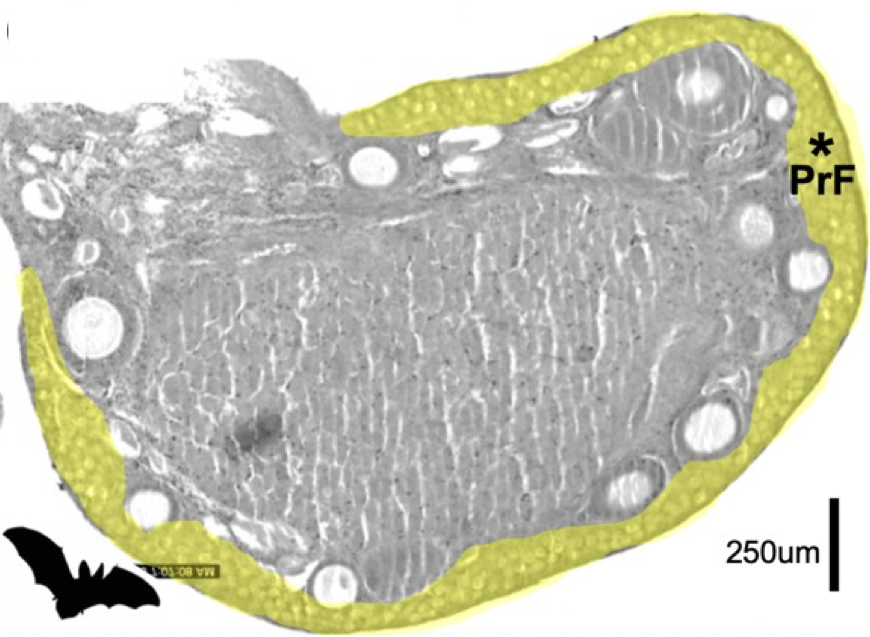
Our research explores how bats achieve this. Do they begin life with more ovarian follicles? Do they lose them more slowly? Or can they maintain or even replenish them later in life? By studying bat ovaries across development and adulthood—and comparing across diverse species—we are uncovering cellular and molecular strategies that support long-term reproductive health.

Our goal is not just to understand bats, but to learn from them. By identifying mechanisms that allow bats to preserve their ovarian reserve, we aim to uncover new ways to slow or prevent reproductive aging in humans. This work has the potential to reshape how we think about fertility, with implications for extending reproductive lifespan, improving women’s health, and developing new therapeutic approaches inspired by nature’s own solutions.


Why this work matters

Nature-inspired solutions for lifelong women’s health

Our research in bats has potential to:

  • Reveal how fertility can last longer, uncovering natural ways to slow reproductive aging and preserve the ovarian reserve

  • Inspire new fertility treatments, using bat biology to guide innovative, nature-inspired therapies

  • Improve lifelong health for women, by connecting reproductive aging to overall health and longevity


Saccopteryx bilineata NEW_6634-1.jpg

Some results from our research

Aging bats have more ovarian reserves

For decades, scientists have assumed that ovarian aging is similar across mammals, with a steady loss of follicles over time. Our NIH-funded research findings suggest that bats challenge this pattern. Bats appear to begin with and maintain a much larger ovarian reserve well into adulthood, pointing to biological mechanisms that can slow or reshape reproductive aging.

AJ%2BCS24%2Bopsin.jpg

Bats repeatedly lose color vision

Few people are aware that bats have good night AND day vision. Some bats can even see colors thanks to two proteins in their eyes: S-opsin which detects blue/UV light and L-opsin which detects green/red light. Many bats, however, lack S-opsin and cannot distinguish colors. In a large, collaborative NSF-funded project, we found that S-opsin has been lost >12 times in our bat group.

bat_skull_CT.jpg

Bat teeth inform evolutionary rules

A long-standing question in biology is why some morphologies have frequently evolved, while others – though theoretically possible – seemingly have never evolved. In an NSF-funded project using the diverse teeth of bats as a model system, we identified rules of developmental biases that shaped the morphological diversification of bat molars.